As a CEO or CFO preparing for a board meeting, the temptation is to show how “busy” the internal talent team has been. You might be tracking the number of CVs screened, first-round interviews conducted, or even the hours spent sourcing on LinkedIn.
Here’s the hard truth: your board doesn’t care.
They aren’t interested in the operational churn of recruitment. They are interested in outcomes. Every week a critical GTM leadership position remains vacant is another week of lost revenue, missed targets, and mounting pressure from investors. Presenting a flurry of activity with no tangible results is the fastest way to lose credibility. The worst answer you can give your board is, “we’re still looking.” It signals a lack of control, a flawed process, and an inability to solve a business-critical problem.
Boards think in terms of opportunity cost. An open VP Sales role isn’t just a gap in the org chart; it’s a direct hit to the P&L. It’s a quarter of missed bookings, a delay in entering a new market, or a competitor gaining ground. They hold the CEO directly accountable for filling these roles with A-players who can deliver results, fast.
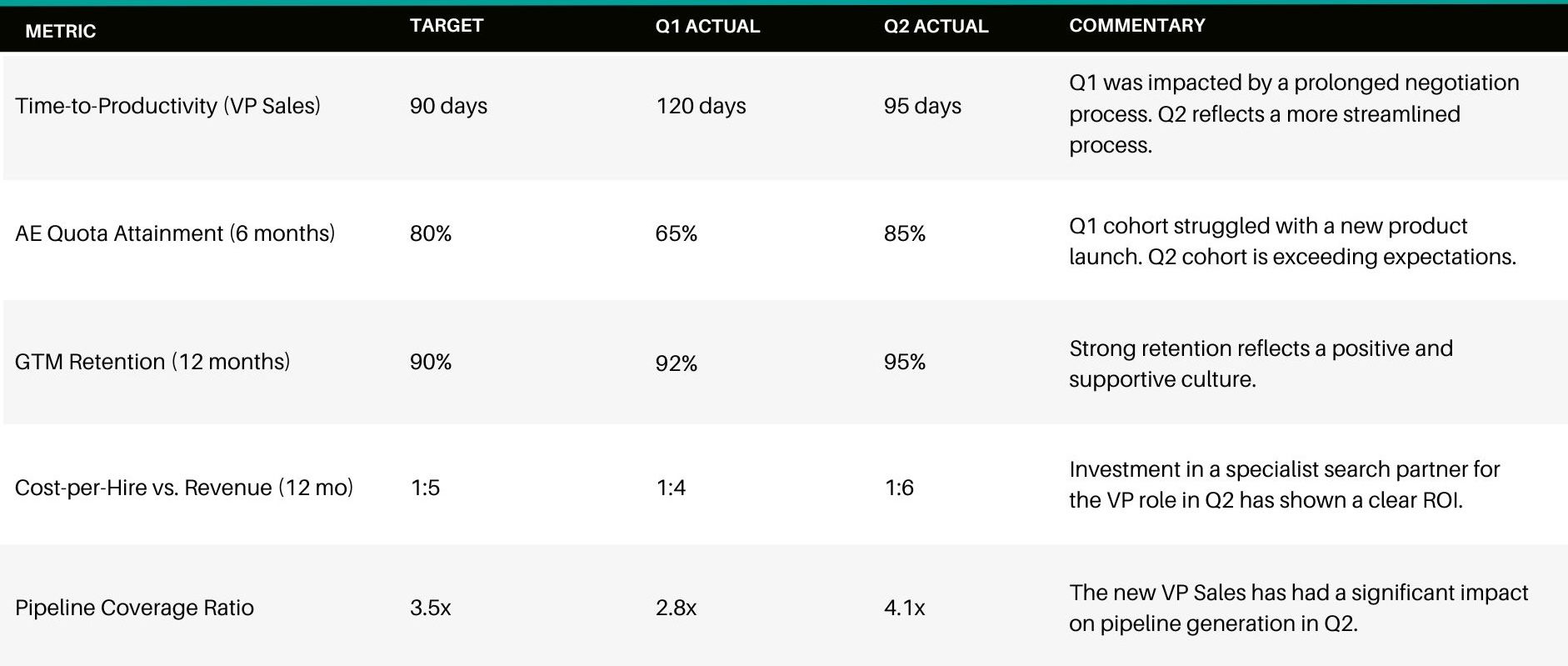
To speak the board’s language, you need to report on metrics that tie directly to commercial outcomes. Forget vanity metrics. Focus on these five critical indicators of hiring success.
Time-to-Productivity: This is not time-to-hire. Time-to-productivity measures the time from the start of a search to the point where the new hire is fully ramped and contributing to revenue. For a VP Sales, this could be their first major deal closed or achieving a specific pipeline generation target. It’s the ultimate measure of a successful hire and an efficient onboarding process.
Quota Attainment at 6 & 12 Months: This is the clearest indicator of a successful sales hire. Are your new account executives hitting their quota within the first two quarters? Is your new VP of Sales building a team that performs? Tracking quota attainment at the 6 and 12-month marks provides a clear, data-backed view of hiring quality.
Retention at 12 & 24 Months: High churn in your GTM team is a massive red flag for boards. It suggests a problem with your hiring profile, your culture, or your leadership. Tracking retention rates for new hires at the 12 and 24-month marks demonstrates that you are not just filling seats, but building a sustainable, high-performing team.
Cost-per-Hire vs. Revenue Generated: This metric frames recruitment as an investment, not a cost. Calculate the total cost of a hire (including agency fees, advertising, and internal time) and compare it to the revenue that hire generates in their first 12-24 months. A strong ROI demonstrates the value of a strategic approach to talent acquisition.
Pipeline Coverage Ratio: This metric, while not a direct hiring metric, is a key indicator of the health of your GTM engine and the effectiveness of your sales leadership. Boards want to see a healthy pipeline that can support future growth. A strong pipeline coverage ratio (typically 3-4x the target) is a sign of a well-run sales organisation, which is a direct reflection of the quality of your GTM leadership.
Instead of a narrative about how hard you’re looking, present a clear, data-driven framework that shows you are in control of the process. This builds confidence and allows for a more strategic conversation about the challenges and opportunities in your GTM hiring.
Here is a sample board reporting framework you can adapt:
This approach shifts the conversation from “we’re looking” to “here’s our performance, here’s what we’ve learned, and here’s our plan to improve.”
Boards understand that speed is critical in a competitive market. Every week a key GTM role remains open is a week of lost ground. They expect CEOs to act with urgency and to have a clear plan for filling critical roles. This is where the “hire ahead of the curve” principle comes into play.
Boards want to see that you are hiring for next quarter’s targets, not this quarter’s. They expect you to anticipate the needs of the business and to be building the team that will deliver future growth. This proactive approach to hiring demonstrates strategic thinking and a forward-looking mindset.
VCs have clear expectations for the composition of your GTM team at each funding stage. These expectations are based on a deep understanding of what it takes to scale a SaaS business.
Seed Stage: At this stage, VCs are looking for a founder-led sales motion. They want to see that the founders are deeply involved in the sales process and have a clear understanding of the customer’s pain points. The first GTM hire is often a versatile “utility player” who can handle a variety of tasks, from lead generation to closing deals.
Series A: By Series A, VCs expect to see the beginnings of a repeatable sales process. This means you have a small team of account executives who are consistently hitting their numbers. You should also have a clear understanding of your ideal customer profile and the key metrics that drive your GTM engine.
Series B: At Series B, the focus is on scaling the GTM team. VCs want to see a clear plan for hiring and onboarding a large number of new reps. You should also have a dedicated sales leader in place who has experience building and managing high-performing teams.
Series C: By Series C, you should have a fully-fledged GTM organisation with specialised roles for sales, marketing, and customer success. VCs will be looking for a sophisticated, data-driven approach to GTM, with a clear focus on efficiency and profitability.
Justifying the cost of a specialist recruitment partner to a board can be a challenge. However, by framing it as an investment with a clear ROI, you can make a compelling case. The key is to focus on the value that a specialist partner brings to the table.
A specialist firm like Strong Search has a deep understanding of the GTM talent landscape. We know the A-players, we know what it takes to attract them, and we have a proven process for delivering results. This allows us to fill critical roles faster, with better candidates, which translates into a clear ROI.
Here’s a simple framework for calculating the ROI of a recruitment partner:
Calculate the cost of the open role: This includes the lost revenue, the impact on team morale, and the opportunity cost of not having a leader in place.
Calculate the cost of the hire: This includes the recruitment fee, the new hire’s salary, and any other associated costs.
Calculate the revenue generated by the new hire: This should be based on their expected quota attainment and the average deal size.
By presenting a clear, data-backed case for the ROI of a recruitment partner, you can demonstrate that you are making a strategic investment in the future of the business.
Not all boards are created equal. Some boards have a deep understanding of GTM hiring and can be a valuable resource for CEOs. Other boards are less experienced in this area and may have unrealistic expectations.
Boards that understand GTM hiring will:
- Focus on the metrics that matter
- Understand the importance of hiring ahead of the curve
- Appreciate the value of a specialist recruitment partner
- Act as a strategic partner to the CEO
Boards that don’t understand GTM hiring will:
- Push for a “spray and pray” approach to recruitment
- Question the cost of recruitment fees
- Micromanage the hiring process
As a CEO, it’s your job to educate your board on the nuances of GTM hiring and to set realistic expectations. By presenting a clear, data-driven approach, you can build trust and confidence with your board, regardless of their level of experience in this area.
Ultimately, the board holds the CEO accountable for GTM hiring outcomes. They expect you to be the driving force behind building a world-class GTM team. This means you need to be deeply involved in the hiring process, from defining the ideal candidate profile to closing the deal.
Strong Search helps CEOs present confident hiring plans to their boards. We provide the data, the insights, and the market intelligence you need to make a compelling case for your hiring strategy. We act as an extension of your team, providing the expertise and the network you need to attract and hire the best GTM talent in the market.
What are the biggest red flags for a board when it comes to GTM hiring?
A lack of a clear process, a focus on vanity metrics, and a reactive approach to hiring are all major red flags. Boards want to see that you are in control of the process and that you have a clear plan for building a high-performing team.
How can I get my board to approve the cost of a specialist recruitment partner?
Focus on the ROI. Show them the cost of leaving a critical role open and the value that a specialist partner can bring in terms of speed, quality, and market intelligence. Present a clear, data-backed case that frames the recruitment fee as a strategic investment, not a cost.
What’s the one thing I can do to improve my GTM hiring process?
Start tracking the right metrics. Move away from vanity metrics like CVs reviewed and start tracking the metrics that matter: time-to-productivity, quota attainment, retention, and cost-per-hire vs. revenue generated. This will give you a much clearer picture of your hiring performance and allow you to make more informed decisions.
How do I know if my board understands GTM hiring?
Pay attention to the questions they ask. If they are focused on the metrics that matter and are asking strategic questions about your hiring plan, then they probably have a good understanding of GTM hiring. If they are focused on vanity metrics and are questioning the cost of recruitment fees, then you may need to educate them on the nuances of GTM hiring.
How can Strong Search help me with my GTM hiring?
Strong Search is a specialist GTM recruitment firm. We have a deep understanding of the SaaS talent landscape and a proven process for delivering results. We can help you to define your ideal candidate profile, attract the best talent in the market, and present a confident hiring plan to your board. We act as a strategic partner to our clients, providing the expertise and the network you need to build a world-class GTM team.
Ready to build a GTM team that will impress your board and drive growth? Contact the Strong Search team today at https://www.strongsearch.co.uk/contact.