The US market is the siren song for ambitious EMEA SaaS founders. It represents the single largest, most homogenous, and highest-spending software market in the world. The prize is enormous: access to a $412 billion SaaS market, a deep pool of capital, and a culture that celebrates and rewards innovation. But for every European company that finds its fortune across the Atlantic, many more find their ambitions shattered on the rocks of poor planning and flawed execution. The US is, without a doubt, the most common and most expensive expansion mistake an EMEA SaaS company can make. The graveyard of well-funded, promising European startups that failed to launch in the US is vast. They underestimate the competition, misunderstand the culture, and, most critically, they get their first go-to-market (GTM) hire disastrously wrong.
Your first hire in a new market isn’t just an employee; they are your company’s living, breathing embodiment in that region. This person carries a disproportionate weight. They are your brand ambassador, your cultural translator, and your primary source of market intelligence. Get this hire right, and you build a strong foundation for growth. Get it wrong, and you not only burn significant capital but also damage your brand reputation before you’ve even started. A bad first hire can set you back 12-18 months, a lifetime in the fast-moving SaaS world. This isn’t just about finding someone who can sell; it’s about finding a foundational pillar for your entire US operation. For more on this, see our post on the [/blog/cost-of-bad-hire-enterprise-saas](real cost of a bad hire).
Many founders default to hiring a VP of Sales as their first US hire. The logic seems sound: we need to sell, so let’s hire a sales leader. This is often a critical error. Hiring a senior leader before you have product-market fit in the new region is a recipe for frustration. A strategic leader needs a team to lead and a proven playbook to scale. Dropping them into a new market and expecting them to build from scratch while also carrying a quota is a fantasy. We’ve written about this in detail in our post on [/blog/hiring-first-vp-sales-saas](hiring your first VP of Sales).
For many early-stage companies, the optimal first hire is a senior, entrepreneurial Account Executive or a Country Manager. This individual should be a ‘doer’ first and a ‘manager’ second. They need the experience to navigate the US market, the credibility to close those crucial first deals, and the hunger to build something from the ground up. They are your on-the-ground validation engine. Only once they have proven the playbook and started to generate consistent revenue should you consider hiring a more senior, team-building leader like a VP of Sales.
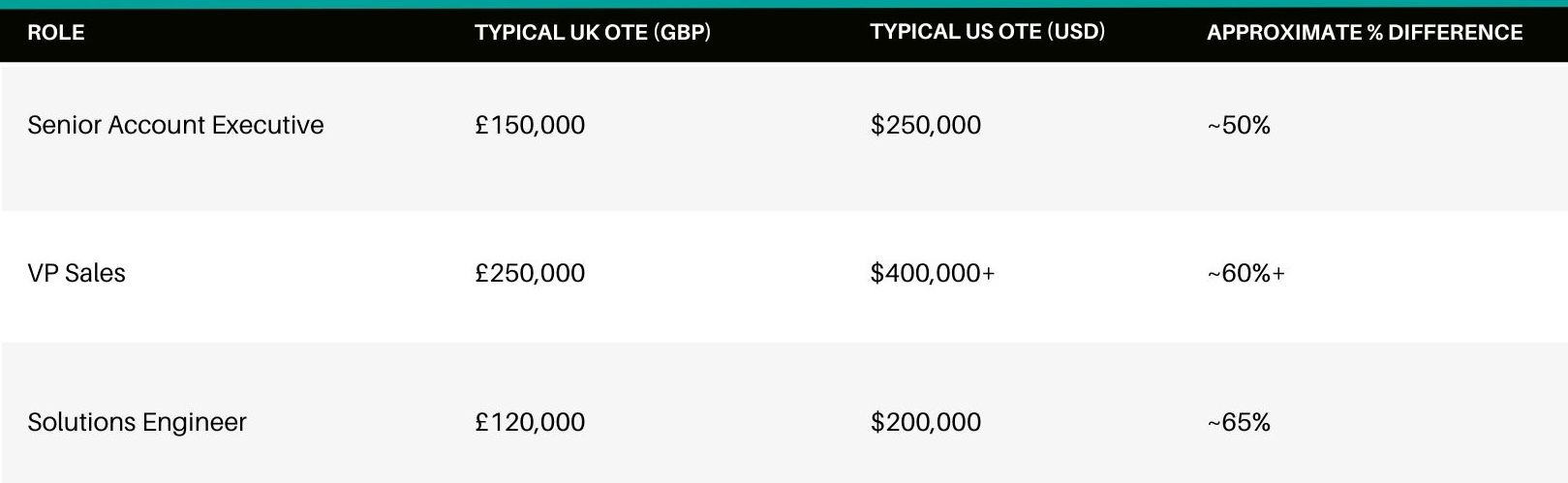
Prepare for sticker shock. US GTM compensation is, on average, 40-60% higher than in the UK and EMEA. A senior Account Executive in the UK might have a base salary of £95,000, while their counterpart in a major US city could command a base of $150,000 (£120,000) or more, with a significantly higher On-Target Earnings (OTE) potential. This isn’t just a gap; it’s a chasm. Founders who try to apply EMEA salary bands to the US market will fail to attract top talent. You are not just competing with other EMEA companies; you are competing with well-funded US-based startups and tech giants who are used to paying top dollar for the best people.
Furthermore, the structure of compensation packages differs. US sales professionals typically expect a higher proportion of their compensation to be variable, often a 50/50 split between base and commission. In the UK, a 60/40 or even 70/30 split in favour of the base salary is more common. You must adapt your compensation philosophy to the expectations of the US market.
The ‘player-coach’ is a mythical creature in the world of SaaS startups. The idea is seductive: hire one person to both sell and build a team. In reality, this rarely works. The skills required to be a top-performing individual contributor are different from those required to be a great manager. An exceptional seller is focused on their own quota, their own deals. A great manager is focused on enabling their team to succeed. Asking one person to do both jobs simultaneously means they will likely do both poorly. They will either focus on their own sales to hit their number, neglecting their team, or they will focus on managing, and their own sales will suffer. Don’t fall into this trap. Hire for the role you need now, and be prepared to hire for the next stage of growth when the time is right.
While the world has embraced remote work, the US market, particularly for enterprise sales, still places a high value on in-person interaction. For high-value, complex deals, face-to-face meetings build trust and rapport in a way that video calls cannot fully replicate. While you may not need a physical office from day one, you should expect your first US hire to be travelling to meet customers. A fully remote hire who is unwilling to travel may struggle to gain traction in a competitive market. The decision of where to base your first hire is therefore critical.
A great CSM is an expert practitioner. They excel at managing a book of business, building relationships, and executing playbooks. A great VP of CS is a strategist and a builder. They need to design the playbooks, architect the systems, and build the team. They are focused on the how and the why at a strategic level, not just the what of day-to-day account management. Promoting your top CSM without the requisite strategic and leadership experience is a recipe for failure. You lose your best CSM and gain an ineffective leader.
Don’t just default to New York or San Francisco. While these cities have a high density of tech talent, they are also the most expensive and competitive markets. The right location for your first US hire depends on your Ideal Customer Profile (ICP). Where are your customers located? If you sell to the financial services industry, New York makes sense. If you sell to the automotive industry, you might be better off in Detroit. Consider tier-two tech hubs like Austin, Denver, or Atlanta, where the cost of living is lower, but the talent pool is still strong. A geographically-focused strategy will be more effective than a scattergun approach.
The US legal and employment landscape is vastly different from the UK and EMEA. The concept of ‘at-will’ employment, which allows either party to terminate the employment relationship at any time for any reason (or no reason at all), is a significant departure from the more protective labour laws in Europe. However, this doesn’t mean you can act with impunity. State-level regulations, particularly in places like California and New York, add layers of complexity. You will need to offer competitive benefits packages, including health insurance and a 401(k) retirement plan, to attract and retain talent. Navigating this landscape requires specialist legal and HR advice. For more on this, see our post on [/blog/executive-search-vs-recruitment-agency](the difference between executive search and recruitment agencies).
Hiring in the US takes time. If you are working with a specialist recruitment partner like Strong Search, you can expect the process to take 4-8 weeks from starting the search to the candidate accepting an offer. If you try to go it alone, without an established network or understanding of the market, you can easily double that time to 12-16 weeks. And that’s just to get the hire. It will then take another 3-6 months for that new hire to ramp up and start delivering results. Be realistic with your timelines and your board. US expansion is a marathon, not a sprint.
Don’t underestimate the cultural differences between the UK/EMEA and the US. Americans are typically more direct in their communication style. They are more comfortable with self-promotion and are more assertive in negotiations, particularly around compensation. The pace of business is faster, and there is a greater sense of urgency. EMEA founders who are not prepared for these cultural nuances can find themselves at a disadvantage. It’s crucial to have a US hire who can act as a cultural bridge, translating not just the language but also the unspoken rules of business.
Making your first US GTM hire is one of the highest-stakes decisions you will make as a founder. The cost of getting it wrong is immense. This is where a specialist partner can be invaluable. At Strong Search, we have a deep, established network of GTM leaders and top-performing sales talent across the US. We understand the nuances of the market, the compensation benchmarks, and the cultural dynamics. We don’t just find you a candidate; we find you the right candidate. We de-risk your US expansion by leveraging our expertise and our network to ensure your first hire is a foundation for success, not a costly mistake. Learn more about our approach in our post on [/blog/retained-executive-search-saas](retained executive search).
What is the biggest mistake EMEA companies make when expanding to the US?
The most common and costly mistake is getting the first GTM hire wrong. Companies often hire a senior leader too early or someone without the right blend of strategic and execution skills. This first hire is foundational, and a misstep can set the company back by over a year.
How much more expensive is it to hire in the US compared to the UK?
On average, you should budget for GTM compensation to be 40-60% higher in the US than in the UK. This varies by role and location, but it’s a significant financial uplift that founders must be prepared for.
Should our first US hire be remote or in an office?
While remote work is common, for enterprise sales, in-person interaction remains highly valued in the US. Your first hire should be willing and able to travel to meet customers. The physical location should be determined by where your customers are, not just where talent is concentrated.
What is ‘at-will’ employment?
‘At-will’ employment is the standard in 49 US states. It means an employer or employee can terminate the employment relationship at any time, for any reason (or no reason), as long as it’s not an illegal reason (e.g., discrimination). This is a major difference from the contractual, notice-period-based employment common in the UK and EMEA.
How important is a US-specific pricing strategy?
A US-specific pricing strategy is critical. Many EMEA companies underprice their products in the US market. You need to account for the higher value perception, the competitive landscape, and the higher cost of sale. A simple currency conversion of your EMEA pricing is rarely the right approach.
Your first US GTM hire is a critical, company-defining decision. Don’t leave it to chance. Partner with a specialist who understands the market, the talent, and the stakes.
Plan your US market entry with Strong Search