Your sales team is hitting its activity metrics. The pipeline looks healthy. But your win rates are flat, and deals keep stalling in the technical validation stage. Your top account executives (AEs) are spending more time in deep-dive technical demos than they are selling. Sound familiar? You might be overlooking the most critical, yet undervalued, function in your go-to-market (GTM) organisation: presales.
In the world of complex enterprise SaaS, where products are intricate and buyers are technically savvy, a strong presales or solutions engineering (SE) function is not a luxury; it is a necessity. These are the individuals who bridge the gap between a compelling sales narrative and the hard reality of technical implementation. They are the unsung heroes who provide the technical validation, handle the toughest objections, and ultimately, build the buyer’s confidence to sign on the dotted line.
This article will explore why presales is the secret weapon for SaaS companies looking to increase win rates, accelerate sales cycles, and build a scalable revenue engine. We will cover when to hire your first SE, what to look for, and how to structure the function for success.
Still not convinced? Let’s look at the numbers. Companies with strong presales functions are not just incrementally better; they are in a different league. According to a study by McKinsey, companies with effective presales engagement see a 6 to 13% improvement in revenue. But the impact on win rates is even more dramatic. Companies with highly developed presales functions consistently achieve win rates of 40 to 50% in new business and a staggering 80 to 90% in renewal business [1].
These are not vanity metrics. Higher win rates translate directly to a more efficient sales engine, a lower cost of customer acquisition (CAC), and a faster path to profitability. In a competitive market, a 30-50% higher win rate on complex, high-value deals is the difference between leading the market and being left behind.
One of the most common misconceptions about presales is that it adds another layer of complexity and slows down the sales process. The reality is the opposite. A skilled presales team is an accelerant, removing friction and de-risking the purchase for the buyer. They achieve this in several ways. Firstly, they provide earlier technical validation. Presales engineers can quickly and accurately assess the prospect’s technical environment, identify potential integration challenges, and confirm that the solution is a viable fit. This avoids wasted time on deals that were never going to close. Secondly, they offer proactive objection handling. The best SEs don’t just answer technical questions; they anticipate them. They have the technical credibility to address concerns from the CTO, the Head of Engineering, and the security team, often before they become major roadblocks. Finally, they focus on proof of value, not just features. Rather than just demonstrating product features, presales builds tailored demos and proofs of concept (POCs) that directly address the prospect’s specific pain points and use cases. This shifts the conversation from “what your product does” to “what your product can do for us..”
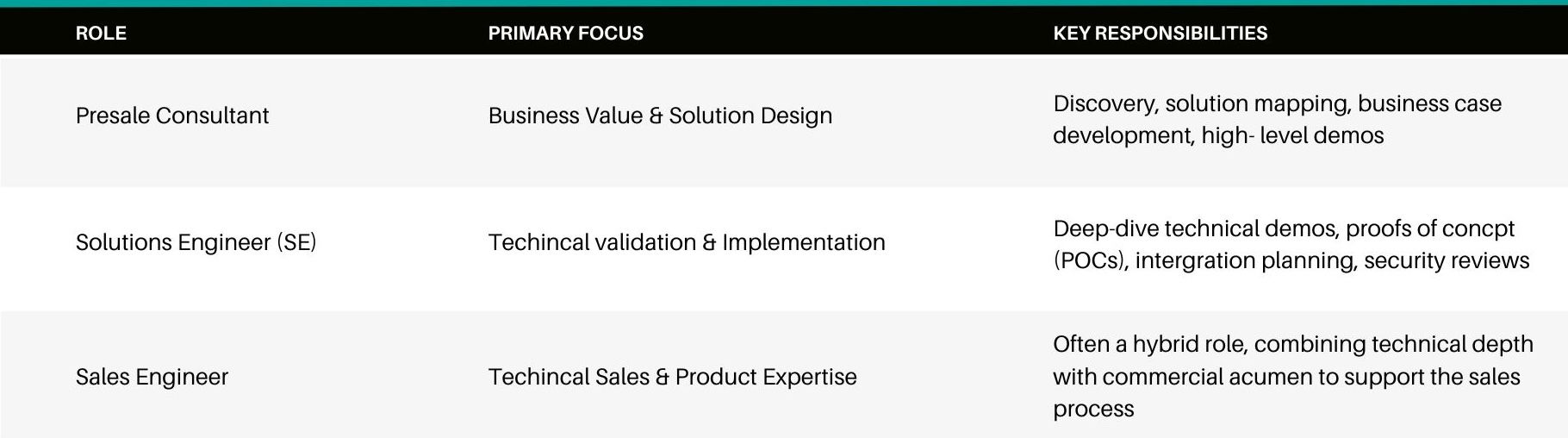
The terminology in the presales world can be confusing, with titles often used interchangeably. While the core function remains the same, there are subtle but important distinctions to understand:
Ultimately, the title is less important than the function. What matters is that you have individuals on your team who can effectively bridge the gap between your product and the prospect’s technical and business requirements. For the rest of this article, we will use the term “Solutions Engineer” or “SE” to refer to this function.
The timing of your first SE hire is crucial. Bringing in an SE too early can be a drain on resources, but waiting too long can stifle growth and lead to lost deals. Several key triggers indicate it’s time to make that critical hire. A primary indicator is deal complexity. If your sales cycles are lengthening and deals are getting stuck in technical evaluations, it’s a clear sign. This is especially true when prospects are asking increasingly complex questions that your Account Executives (AEs) struggle to answer without significant product team involvement. Another trigger is the sales cycle length. If your average sales cycle for enterprise deals is consistently exceeding 90-120 days, an SE can help compress this by providing rapid technical validation and proof of value. The technical depth of your product is also a major factor. As your product matures and becomes more feature-rich, the technical explanation required to sell it increases. An SE can articulate this complexity in a way that resonates with technical buyers. Furthermore, if you are experiencing a high demand for proofs of concept (POCs) and your product team is stretched thin supporting these, an SE can own the end-to-end POC process, from scoping to delivery. Finally, competitive pressure can be a strong motivator. In a crowded market, differentiation often comes down to technical superiority and the ability to demonstrate real-world value. An SE can be your competitive edge.
Delaying this hire can have significant consequences, including missed revenue targets, frustrated sales teams, and a damaged reputation. The cost of a bad hire in enterprise SaaS can be astronomical, easily running into six figures when you factor in lost revenue, recruitment costs, and the impact on team morale.
Once you’ve decided to invest in presales, the next question is how to structure the team. The most critical metric to consider is the presales-to-AE ratio. This ratio is a key indicator of how effectively your sales organisation is supported and can have a significant impact on revenue.
While there is no one-size-fits-all answer, industry benchmarks provide a useful starting point. For most SaaS companies, the ideal ratio falls somewhere between 1:2 and 1:4, meaning one SE for every two to four AEs. The optimal ratio for your organisation will depend on several factors. Deal complexity is a primary consideration; the more complex your product and the sales process, the lower the ratio should be (i.e., more SEs per AE). Product maturity also plays a role, as early-stage products often require more presales support to handle technical questions and build credibility. Finally, your sales model is a key factor. A high-velocity, transactional sales model may require a higher ratio, while a high-touch, enterprise sales model will need a lower ratio.
It’s important to note that a lower ratio, while representing a greater investment, can lead to a significant increase in revenue per rep. For example, sales teams with a 1:1 ratio have been shown to have an average revenue per rep of $3.2M, while teams with a 1:5 ratio average only $2M per rep.
If you’ve ever tried to hire a great SE, you know it’s a challenge. The role requires a rare and potent combination of skills that are not easily found in a single individual. A top-tier SE is, first and foremost, technically deep. They have a genuine understanding of the technology, the architecture, and the competitive landscape. They can go toe-to-toe with the most technical buyers and earn their respect. Secondly, they are commercially astute. They understand the business context of the sale and can connect technical features to business value and articulate a compelling ROI. Thirdly, they are a gifted communicator. They can explain complex technical concepts to a non-technical audience without resorting to jargon and are equally comfortable in the server room and the boardroom. Finally, they are a natural problem-solver. They are curious, analytical, and relentless in their pursuit of a solution, thriving on a good challenge and not afraid to get their hands dirty.
This unique blend of skills makes top presales talent a scarce and valuable commodity. It’s why working with a specialist recruitment firm that understands the nuances of the GTM talent market can be a game-changer.
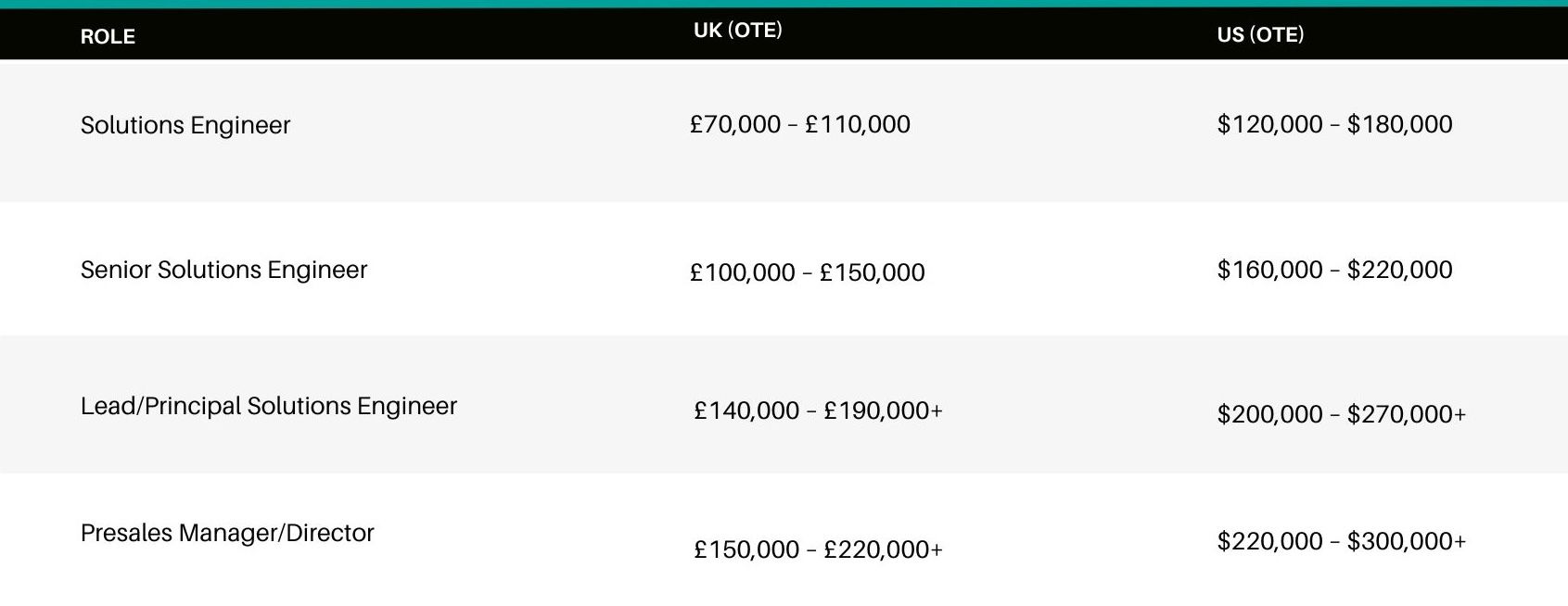
Given the scarcity of top presales talent, it’s no surprise that compensation for these roles is competitive. To attract and retain the best, you need to be prepared to offer a compelling package. Here’s a look at typical compensation benchmarks for presales roles in the UK and the US:
Note: OTE (On-Target Earnings) includes base salary and variable compensation. These are general benchmarks and can vary based on location, company stage, and individual experience.
As the presales function matures, the need for dedicated leadership becomes apparent. A Director or VP of Presales is not just a senior SE; they are a strategic leader who can build and scale the function, align it with the broader GTM strategy, and ensure that it is delivering maximum impact. The role of a presales leader is multifaceted. They are responsible for building and developing the team, which includes attracting, hiring, and retaining top presales talent. They must also define and optimise the presales process, implementing best practices for discovery, demos, POCs, and technical validation. A key part of their role is to align with sales and product, ensuring that the presales team is working in lockstep with these organisations. Furthermore, they are tasked with measuring and reporting on performance, tracking key metrics such as win rates, sales cycle length, and POC success rates. Finally, a presales leader must be the voice of the customer, providing valuable feedback to the product team based on insights from the field.
Hiring a strong presales leader is a critical step in scaling your GTM organisation and ensuring that your presales function is a strategic asset, not just a support function. Read our blog – hiring your first VP Sales.
A common objection to investing in presales is the cost. Why hire an SE when you could hire another AE? It’s a fair question, but it’s based on a false premise. Presales is not a cost centre; it’s a revenue multiplier.
The data speaks for itself. As we’ve seen, companies with strong presales functions have significantly higher win rates. This means that for the same number of leads, you are closing more deals and generating more revenue. Furthermore, by accelerating the sales cycle, presales allows your AEs to close deals faster and move on to the next opportunity, increasing their overall productivity.
Consider this scenario: you have two AEs, each with a quota of £1M. You can either hire a third AE, or you can hire an SE to support the existing two. While the third AE might bring in an additional £1M in revenue (assuming they hit their quota), the SE could increase the win rate of the existing AEs by 30%, resulting in an additional £600,000 in revenue without increasing the lead generation budget. When you factor in the shorter sales cycles and the ability to close more complex, higher-value deals, the ROI of the SE becomes even more compelling.
What is the ideal background for a Solutions Engineer?
The best SEs often come from a technical background, such as software development, product management, or technical support. However, it’s equally important that they have strong commercial acumen and communication skills. Some of the most successful SEs are former AEs who have a deep technical aptitude and a passion for problem-solving.
How do you measure the performance of a presales team?
Presales performance should be measured by a combination of activity metrics and outcome metrics. Activity metrics include the number of demos delivered, POCs completed, and technical validation sessions conducted. Outcome metrics are more strategic and should be tied to the overall sales performance, such as win rates, sales cycle length, and average deal size.
What is the career path for a Solutions Engineer?
A successful SE has a number of career paths open to them. They can progress to a senior or principal SE role, where they take on more complex deals and act as a mentor to junior members of the team. They can also move into presales leadership, managing a team of SEs. Alternatively, their unique blend of technical and commercial skills makes them well-suited for roles in product management, sales leadership, or even founding their own company.
Should presales report to sales or to a separate function?
There are different schools of thought on this, but the most common and effective structure is for presales to report into the sales organisation. This ensures tight alignment between the two functions and a shared focus on driving revenue. However, it’s important that presales has a distinct identity and is not simply seen as a support function for the sales team.
Ready to unlock the power of presales and build a GTM engine that can scale? At Strong Search, we specialise in helping SaaS companies hire the top GTM talent, from your first SE to your VP of Presales. We understand the unique blend of skills required for success in these roles and have a proven track record of placing high-impact individuals in the world’s leading SaaS companies.
Contact us today to learn more about how we can help you build a world-class presales organisation.
[1] Pepsales AI. (2025, August 20). Presales vs. Sales: Key Tools & Differences. Retrieved from https://www.pepsales.ai/blog/presales-vs-sales-tools-software-differences
Grow Stronger, Globally.