
You have found the right person and they have accepted. The one thing that can still move your start date by a quarter is not the candidate and not the offer. It is the contract they are leaving, and it behaves very differently depending on where in the world they sit.
Every hiring market feels normal from the inside. North American hiring is fast, and where there is friction it usually turns on whether a restriction is enforceable. Most of Europe is built on a different logic, one of longer notice and stronger employee protection. Neither is right or wrong, but neither travels, and the mistake, in every direction, is assuming your home market is how hiring works everywhere.
This is not a warning that cross-border hiring is hard. It is a map, because the delays and the restrictions are almost always predictable, and predictable means plannable. What follows is how the timeline really works in the markets GTM teams hire across most, whichever direction you are moving.
The two levers that actually move your date
Wherever you hire, two levers decide when a new leader can genuinely start, and they catch people out in opposite directions.
The first is time: the notice period, and whether garden leave sits on top of it. This is where teams hiring into Europe get surprised. Notice periods there run far longer than North American norms and, for senior people, routinely reach three months or more. Garden leave can then keep the person paid but unavailable for the whole of it.
The second is the covenant: whether a post-termination non-compete can keep the person out of your business after they leave. This is where teams hiring into North America get surprised, because there is no single answer. Enforceability swings from outright bans to fully enforceable clauses depending on the state or province. And in much of Europe a non-compete is only valid if the former employer pays for it, which changes both how common they are and what their presence tells you.
Get both levers right for the specific market and the rest is scheduling. Get them wrong and you commit to a date, usually in front of a board, that the contract was never going to allow.
At a glance
The headline position in the markets GTM teams hire across most often:
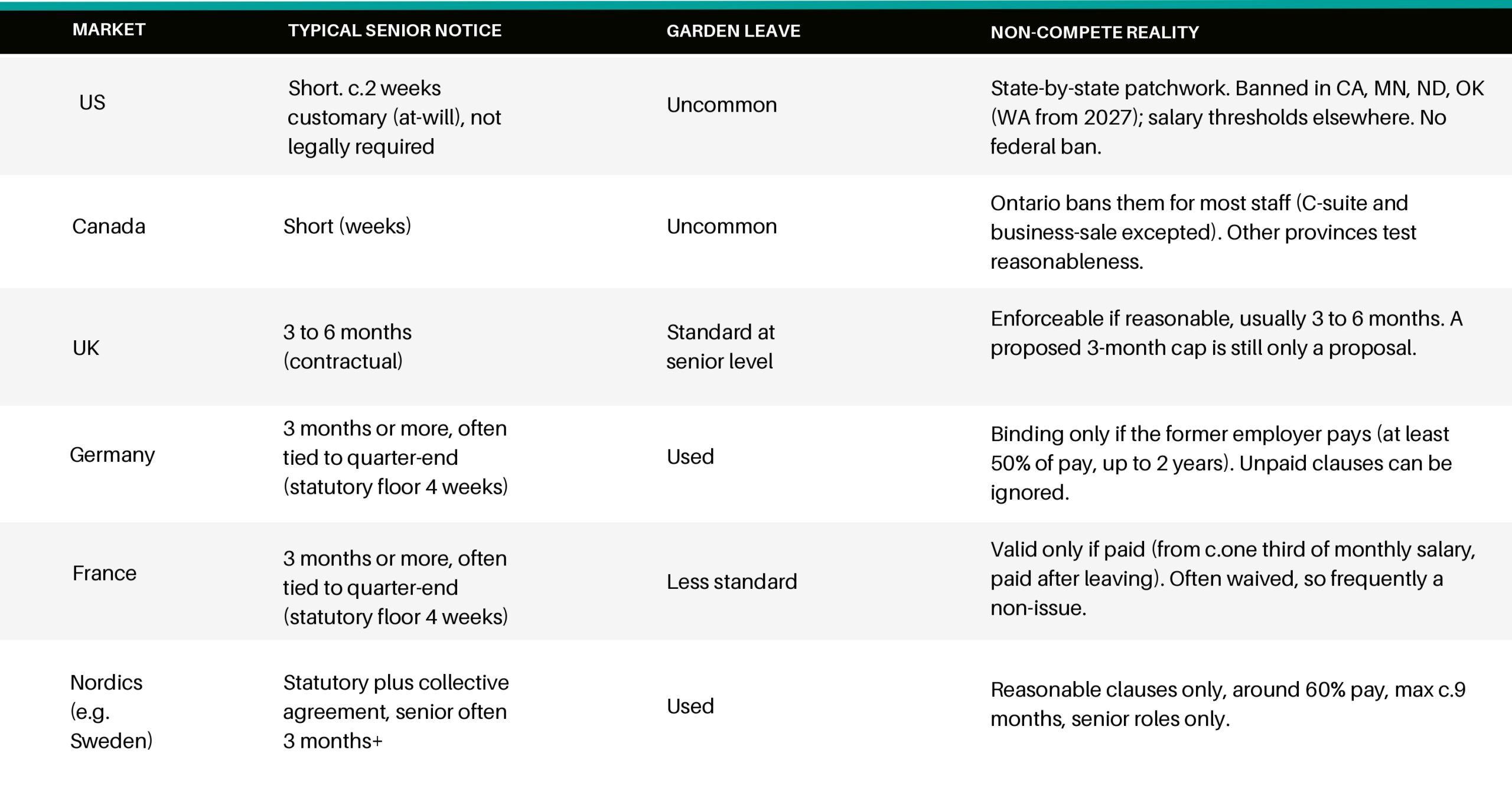
North America: fast to start, a patchwork on covenants
The timeline surprise in the US and Canada is rarely notice. Employment is largely at will in the US, two weeks is customary rather than required, and people can usually start quickly. Garden leave is uncommon.
The complication is the covenant, and there is no national rule in either country. In the US, the FTC’s attempted nationwide ban was blocked in court and has since been formally rescinded, so enforceability is once again purely a matter of state law, and the states disagree sharply. California, Minnesota, North Dakota and Oklahoma void employee non-competes outright, with Washington following in 2027, while others enforce them only above a salary threshold and others still apply a reasonableness test. Two candidates doing the same job in different states can be on completely different footing.
Canada varies the same way, by province. Ontario has banned employee non-competes since late 2021 for all but C-suite executives and sale-of-business situations, while other provinces still test them for reasonableness. So when you hire into North America the question is not how long someone must wait, but whether the clause in their current contract, or the one you want in your own, is worth anything where they actually sit.
The UK: enforceable covenants, but expensive to fight
Notice periods are contractual rather than statutory, and for senior GTM roles they commonly run three to six months. Garden leave is standard at that level, so build the full period into your plan rather than assuming a quick exit.
Post-termination non-competes are enforceable in the UK where they are reasonable and go no wider than necessary to protect a legitimate business interest, usually for three to six months. Around five million UK employees are under one. They can be challenged, but only by bringing a claim, which is often expensive enough to deter it. A government proposal to cap non-competes at three months has been floated, but as of 2026 it remains a consultation with no binding effect, so plan around the clause in the contract in front of you, not the one that might exist one day.
Germany: where the timeline shifts most
Statutory notice starts at four weeks, but that is the floor, not the norm for the people you want. Senior and executive contracts routinely carry three-month notice periods, often longer, and are frequently tied to the end of a calendar quarter rather than a rolling date. A candidate who says yes in January may not start until Q3, before any garden leave is added on top.
The non-compete follows an inverted logic that is worth understanding properly. A post-termination clause is only binding in Germany if the former employer pays for it: at least 50 per cent of the employee’s prior total earnings for the whole restricted period, up to a maximum of two years. An unpaid clause can be set aside. A paid one is a signal worth reading, because the employer has decided this person is worth funding to keep off the market, which tells you it will hold and it will be defended.
France: non-competes are the exception, not the default
France is the market most often misread from outside, though not for the reason most people assume. Non-competes are not banned in France. They are simply expensive and tightly policed, so they are used far more sparingly than in North America.
For a French non-compete to be valid it must protect a genuine business interest, be limited in time and geography (a worldwide clause is void), and, crucially, be paid for. The employer owes financial compensation for the whole restricted period, from roughly one third of the employee’s monthly salary, paid after they have left. Because that is a real and continuing cost, many employers either never include a serious clause or waive it on exit. The practical result is that a French non-compete is often a non-issue, and where one is genuinely in force, someone is paying for it.
In France the delay comes mostly from notice. For cadres, the managerial and executive population you are usually hiring, three months is the standard notice period, set by the applicable collective agreement. So the covenant rarely blocks the hire, but the calendar still does.
The Nordics: reasonable, compensated and narrow
Sweden is representative of the region. Non-competes are enforceable only where reasonable, are normally reserved for genuinely key people, and require compensation of around 60 per cent of monthly income during the restricted period. Duration is typically capped at about nine months, stretching towards eighteen only where the employer has a strong interest to protect, and clauses are often backed by financial penalties to make them stick.
Notice periods follow statute and collective agreements and, for senior hires, commonly reach three months or more. The pattern holds across the region: the covenant is narrow and paid for, and the notice period is the main thing standing between an accepted offer and a first day.
What this means for your timeline
Put the markets side by side and the shape is clear, and it is directional. Hire into Europe and time is the binding constraint: senior notice of three months or more, often with garden leave on top. Hire into North America and time is rarely the issue; the covenant is, because enforceability is a moving, local patchwork. Hire in the other direction, a European or Asian firm placing someone into the US, and the same two questions simply swap priority.
Wherever you are going, a few habits remove most of the risk:
- Ask about notice period, quarter-end alignment, garden leave and any covenant in the first serious conversation, not at offer stage.
- Get local legal input for the specific market. A contract template from one country tells you almost nothing about another, and within the US and Canada it can be wrong one state or province over.
- Read a paid non-compete as intelligence, not just an obstacle: where someone is funding a restriction, they are telling you how much they value keeping this person away from you.
- Plan the start date around the real release date, then set external expectations, especially with the board, to match it.
The same discipline applies across APAC, where Singapore, Japan and Australia each add their own variations. The principle does not change with the map: understand how the local contract behaves before you commit to a date built on how hiring works at home.
The right leader is worth waiting a quarter for, or worth the legal check to protect. The avoidable mistake is committing to a date, or to a covenant, before you understand the market that governs it, and that part is entirely within your control. Get the map right and a cross-border hire becomes a scheduling exercise rather than a nasty surprise.
Talk to Strong Search about de-risking your hiring timeline, wherever your next GTM leader is coming from or going to.
Grow Stronger, Globally.