Across the enterprise software, SaaS and AI companies we speak to, 2027 headcount is either signed off or close to it. Budgets are agreed. Targets are set. The plan assumes new GTM leaders and sellers will be in seat and selling from 1 January.
For a lot of businesses, the calendar says otherwise.
The maths on a January start
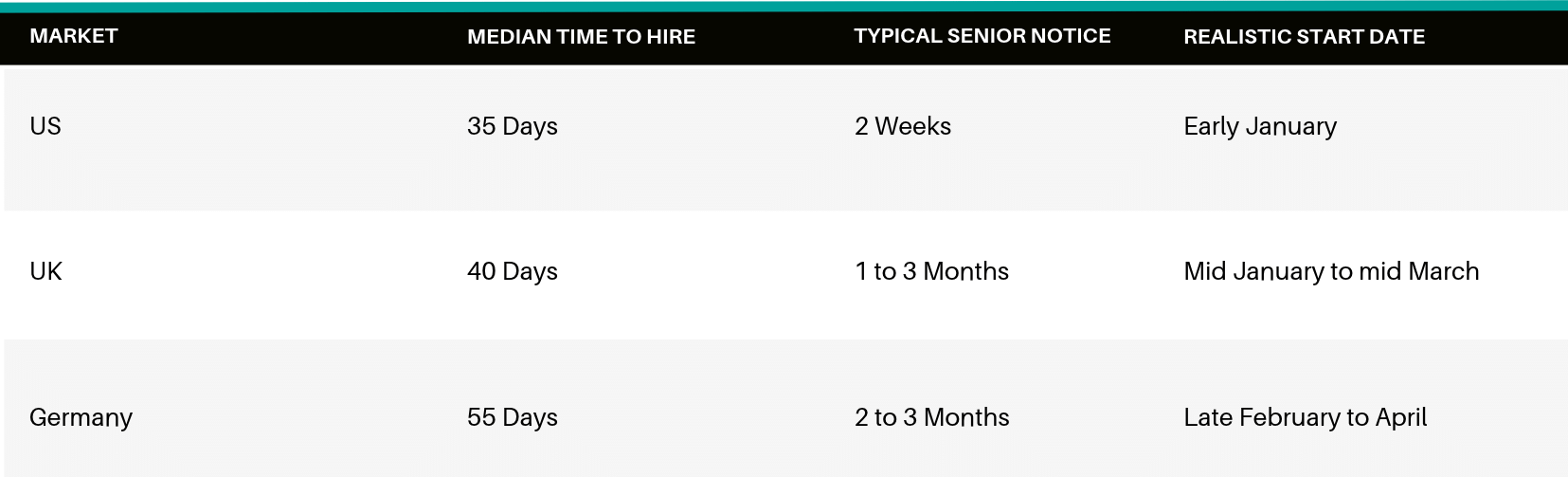
Hiring takes time, and notice periods add more. SmartRecruiters’ latest benchmark puts the median time to hire at 35 days in the US, 40 in the UK and 55 in Germany, across all roles. Senior GTM hires rarely move faster than the average.
Then add notice. In the US, two weeks is the norm. In the UK, senior sales and leadership contracts commonly carry one to three months. In Germany, senior roles may require two to three months, and across much of Europe, longer tenure means longer notice. Our guide to cross-border hiring timelines covers notice, garden leave and non-competes by market.
Start a search today and here’s roughly how that plays out:
In the US, there are still a few weeks to get a hiring process in order. In Europe, a January start is already out of reach for many senior hires. Every week from here pushes the start date later.
The ramp that rarely makes the budget
A start date isn’t a productive date. The Bridge Group’s 2026 research puts average AE ramp at 6.2 months, the longest in the study’s history. An AE in Germany who starts in April is unlikely to be fully productive until October. That’s most of the year gone before the hire is carrying a full number.
So the real question for a CFO isn’t whether to spend on external search. It’s what the empty seat costs while the decision is made.
The cost of an empty seat
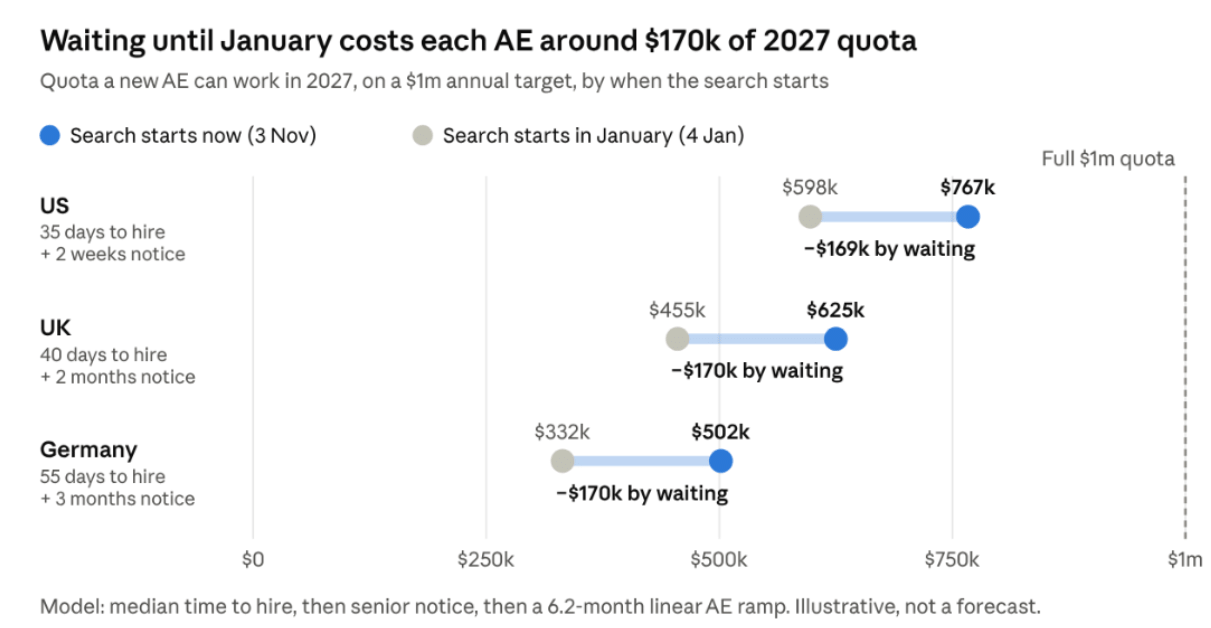
Take an AE carrying a $1m annual quota. Each month that seat sits empty is roughly $83k of quota with nobody working it, before ramp is even counted. Leave it empty through Q1 and a quarter of that number is written off before the hire walks in.
Now run that same AE through the calendar. A two-month delay in starting the search costs around $170k of 2027 quota, wherever you hire. In Germany, even a search that starts today leaves half the year’s number unworked.
Strong Search model using SmartRecruiters median time to hire (2025-26), typical senior notice and Bridge Group 2026 AE ramp (6.2 months). $1m annual quota.
The figures are illustrative, but the logic holds for most GTM roles. A search fee is a one-off cost tied to first-year pay. A vacant seat costs pipeline every month, and that pipeline feeds next year as well as this one. Our GTM Hiring ROI Calculator lets you run the numbers on your own roles, covering vacancy cost, ramp time and revenue impact. For the full working, see our breakdown of the true cost of an open headcount.
A bum on a seat or a top performer
When pressure builds, the temptation is to hire whoever is available. That’s understandable. It’s also expensive, as we’ve covered in the cost of a bad hire in enterprise software.
The Bridge Group found 48% of reps were at quota in 2026. Hire an average seller and the odds of them hitting their number are close to a coin toss. McKinsey’s research on talent found high performers in highly complex roles are up to 800% more productive than average performers. Senior enterprise sales and GTM leadership sit firmly in that category.
The gap between filling a seat and hiring the right person is the gap between a target on a spreadsheet and revenue in the bank.
When the CRO and CFO are looking at different numbers
In many of the businesses we speak to, the CRO and CFO want the same thing: a team that hits next year’s target. They just come at it from different sides.
The CRO needs roles filled and ramped, so the team is ready to perform against the 2027 number from the start of the year. The CFO’s job is to protect the business from spend that doesn’t earn its keep, and external fees are an obvious line to question. That scrutiny is right. It’s part of how well-run businesses stay disciplined.
Where it goes wrong is when holding back on external support becomes the default rather than a decision. A fee is visible on a budget line. The cost of a seat that sits empty through Q1, or is filled by an average hire, is harder to see, but it’s usually far larger. Saving the fee can end up costing the target it was meant to protect.
The way through is to put the same numbers in front of both: the cost of an empty seat, the realistic start and ramp dates in each market, and what external support costs against that. When the investment case is clear, the CFO can back it with confidence and the CRO gets the team in place on time. The GTM Hiring ROI Calculator is a quick way to build that case together.
Where the best sellers are right now
There’s another factor that’s easy to miss. Many of the strongest sellers have already hit their number for 2026. Right now they’re deep in accelerators, closing every deal they can before year end. They aren’t looking at job boards, and they won’t resign before their commission pays out.
That doesn’t make them unavailable. It makes them available to the companies that speak to them now.
The proactive companies we work with are already doing this. We have offers accepted with delayed start dates, so top performers can finish the year, collect what they’ve earned, resign and start in January ready to go. The candidate protects their 2026 earnings and sets up their 2027. The hiring company secures proven talent before the market wakes up. A delayed start does need managing well, particularly when the counter-offer arrives.
Wait until January and you’re competing for the same people as everyone else, after they’ve already had conversations elsewhere.
How to hire a top seller who is still closing the year
A seller in accelerator mode is a different candidate from one who is actively looking. They’re busy, they’re winning, and they have a lot to lose by moving at the wrong moment. The companies that land them build the process around that.
Approach them now, not in January. By the time the new year starts, the best people have already had conversations elsewhere.
Respect their quarter. Keep interviews few and well planned, offer early mornings or video, and avoid their final closing weeks where you can.
Move quickly once there’s interest. A slow process in December loses people. Agree the interview stages and decision-makers before the first conversation.
Understand their commission position. Ask when their year-end commission pays out and what they’d forfeit by leaving early. In many comp plans, commission is only paid if they’re still employed on the payout date, so set the start date after it. Where a gap remains, some companies use a sign-on bonus to bridge it.
Make the offer before the holidays. A signed offer with a January start date gives them the certainty to finish their year strong, and gives you a confirmed hire for Q1.
Plan for the counter-offer. A top performer resigning in January will almost certainly be asked to stay. Talk it through before they resign, not after.
Keep them close until day one. Introduce them to the team, share the territory plan and invite them to your sales kickoff, without asking them to work before their start date. Aligning the start with kickoff means they ramp alongside the rest of the team.
What we see every year
In our experience, January and February bring a wave of calls from companies that have fallen behind. Targets are live, seats are empty and hiring managers are under real pressure. Often external spend was held back in Q4 to protect budget, and the cost of that decision only shows once the new year starts.
That isn’t a criticism. Q4 is busy, budgets take time and internal talent teams are stretched. But the pattern is predictable, which means it’s avoidable.
What to do this month
If 2027 headcount is agreed, or close to it:
Confirm which GTM roles need to be in seat in Q1, and in which markets.
Work backwards from notice periods. European roles need to start now.
Decide where internal capacity will cope and where it won’t.
Get approval for external support before you need it, not after.
Approach top sellers now, run a tight process around their year end, and agree January start dates that protect their commission.
Put your priority roles through the GTM Hiring ROI Calculator so the cost of waiting is on the table when budgets are discussed.
Quick answers
How long does it take to hire a senior salesperson?
SmartRecruiters puts the median time to hire at 35 days in the US, 40 in the UK and 55 in Germany, across all roles. Then add notice: two weeks is the norm in the US, while senior roles in the UK and Europe commonly carry one to three months.
When should we start hiring for a January start?
In the US, by mid November. In the UK and much of Europe, a January start for a senior hire is already difficult, so start now and plan for Q1.
How long does a new AE take to ramp?
The Bridge Group’s 2026 research puts average AE ramp at 6.2 months, the longest in the study’s history.
Can we hire top sellers before their year-end commission pays out?
Yes. Approach them now, keep the process short and set a start date after their commission pays out. Many will accept an offer in December for a January start, so they can collect what they’ve earned and arrive ready to sell.
How Strong Search helps
Strong Search is a global GTM search partner for enterprise software, SaaS and AI companies. We hire across sales, presales, customer success, marketing, RevOps and GTM leadership in the UK, EMEA, North America and APAC. We deliver a qualified shortlist in an average of 12 days, with 100% placement retention and zero refunds. You can see how that works in practice for Tekion’s US sales team and Basware’s expansion across Europe, North America and APAC.
If your 2027 plan relies on GTM hires being in seat early in the year, start by working out what an empty seat costs you with the GTM Hiring ROI Calculator. Then book a call and we’ll help you close the gap.
The right hires don’t just fill roles, they accelerate revenue, strengthen culture, and unlock new markets. Partner with Strong Search to secure the GTM talent your SaaS business needs to grow faster and smarter.